Ads
January 23, 2006

December 01, 2005
USB Attached Oscilloscope To Learn On.
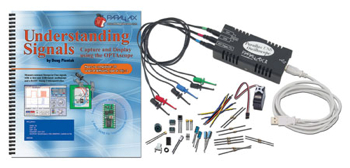
"This small, portable, two-channel digital
oscilloscope has a powder-coated aluminum
case and three pairs of probes. The hardware
connects to your PC with the included USB
cable for both data transfer and power, so
no external power supply is needed. All
oscilloscope controls are managed through a
point-and-click PC software interface. 3
easy-to-use cursor functions measure acquired
signals, with the option to snap to the
waveform. The cursors operate in zoom mode,
allowing close viewing and precise measuring
of signals. Other classic scope features
include variable trigger voltage, external
triggering, waveform measurements (min, max,
frequency, period), and four FFT function
options. The ability to save customized
setups and quality bitmap screen captures
are standard in the software."
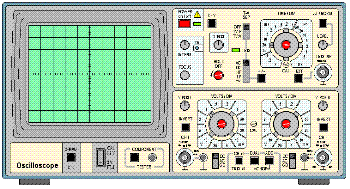
Using an Oscilloscope
November 21, 2005
Radio Ace / RadioMann build your own radio kit.

Build a nostalgic radio with a real vacuum
tube and explore the airwaves as they did
in the 1930’s! Historic technology comes to
life again with 30 engaging experiments.
Assembling this radio is a fun project for
radiomen, tinkers and gadget-buffs of all
ages. Once your radio is up and running,
hunting for radio transmissions becomes a
fun challenge. While learning how the radio
works, you will discover the fundamental
parts of electrical circuits.
Technorati Tags: diy
November 19, 2005
Everyone needs a chemistry kit.

It is hard to find a good chemistry kit
in this day and age. To many people out
there that are the reason we have labels
on our coffee cups that tell us that hot
liquid in the cup will burn you if you
dump it in your lap. Back to the topic
at hand. Thames and Kosmos have a very
sweet looking kit that you can order for
your self or your kids. I think I'll add
one to my christmas list.
October 27, 2005
What sex is your brain?

July 29, 2005
What's that Bug?
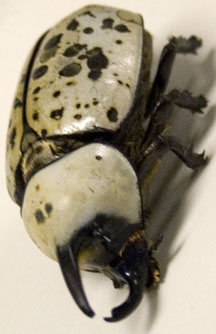
I can't say how many times I have run
across a bug and wondered. What in the
Lords wide creation is that thing?
Here is a site that help you find out.
Just take a photo of your favorite
multi legged friend and send it in for
identification.
link (via exclamation mark)
June 15, 2005
A Stunning Sunset on Mars

What a great photo it was taken on
May 19th, 2005 by the Mars Rover
Spirit. It is good to know that
where ever you are sunsets are still
spectacular.
April 27, 2005
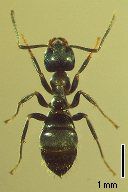
The Japanese Ant Database
April 19, 2005
Metro Wi-Fi via Stratellites
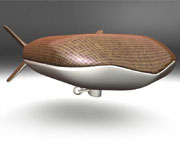
A Stratellite™ is a high-altitude airship that
when in place in the stratosphere will provide
a stationary platform for transmitting various
types of wireless communications services
currently transmitted from cell towers and
satellites. It is not a balloon or a blimp. It
is a high-altitude airship.
Made of Spectra and powered by solar powered
electrical engines, each Stratellite will reach
its final altitude by utilizing proprietary
lifting gas technology. Once in place at 65,000
feet (approx. 13 miles) and safely above the jet
stream, each Stratellite will remain in one GPS
coordinate, providing the ideal wireless
transmission platform. The Stratellites are
unmanned airships and will be monitored from the
Company’s Operation Centers on the ground.
A Stratellite will have a payload capacity of
several thousand pounds and clear line-of-sight
to approximately 300,000 square miles, an area
roughly the size of Texas. However, the Company’s
initial plan is to use one Stratellite for each
major metropolitan area.
October 28, 2004
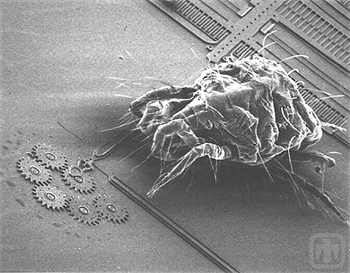
Micro Scale Videos - Bugs Vs. Machines
October 26, 2004
Japanese robotics advancing faster than ever.
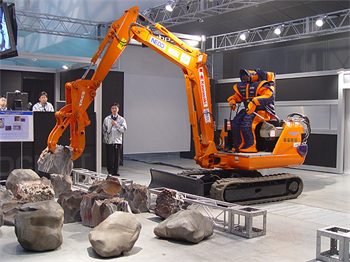
HRP robot operates a backhoe while dressed
in protective gear. It is being tele-operated and
not working in autonomous mode.
link (via misanthropyst)
August 28, 2004
Space Elevator

This post is for Charles over at Shtoink.com
he and I had a long discussion about what a
space elevator was and if I had smoked a big
spliff right before I started the conversation
with him. There is now a proposed competition
like the Ansari X Prize, Elevator:2010 will try
to do for the space elevator what the X Prize
is doing for commercial space flight.
July 10, 2004
Earthquake Maps and Live Seismograph
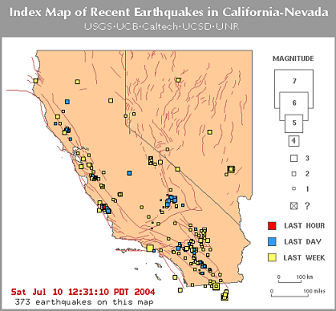
Very nice Index map of recient earthquakes
in California and Navada.

Mori displays streaming seismographic data measured
continuously from a site near the Hayward Fault
above University of California at Berkeley. The
earthquake detector is a Streckeisen STS-1
seismometer that measures vertical ground velocity.
Data is collected by the Berkeley Seismological
Laboratory and relayed to a server in the Alpha Lab.
Your display is delayed 30 seconds due to frame
buffering at the detector.
(via kf6hqc)
June 21, 2004
Photo of a tree being struck by lighting.

link (via boingboing)
How long until you die? The Hayflick Limit

In 1961, and in contradiction to what was
thought at the time, Leonard Hayflick and
Paul Moorhead discovered that human cells
derived from embryonic tissues can only
divide a finite number of times in culture
(Hayflick and Moorhead, 1961). They defined
the stages of cell culture as three phases:
Phase I is the primary culture, when cells
from the explant multiply to cover the
surface of the culture flask. Phase II
represents the time when cells divide in
culture, which will be described briefly.
Once cells cover a flask's surface, they
stop multiplying.
link